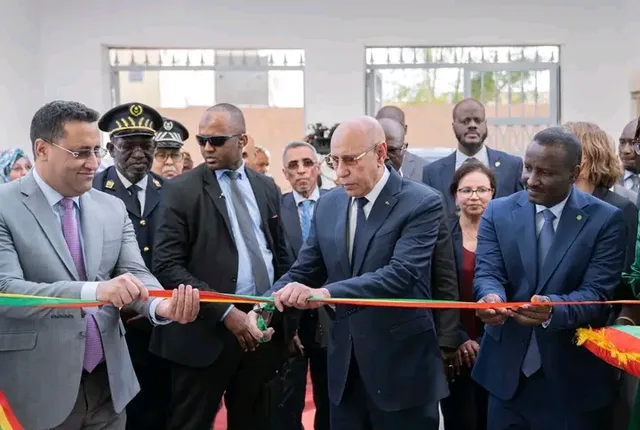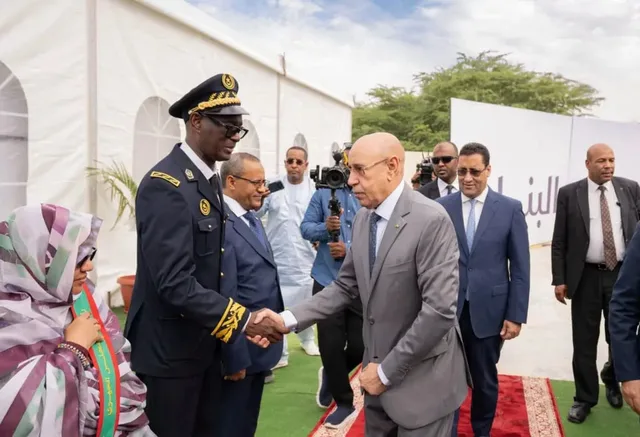
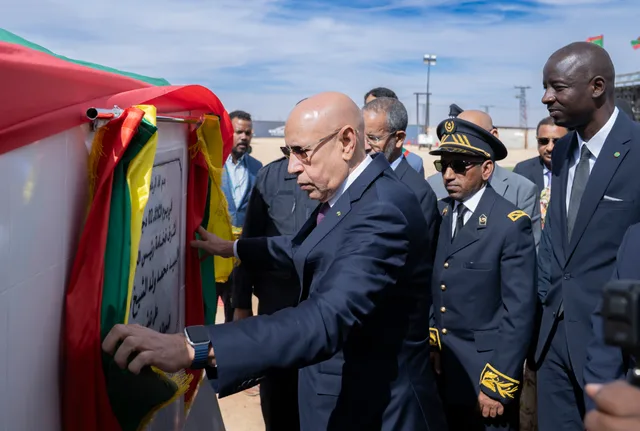
Madar (Nouakchott) - President Mohamed Ould Cheikh El Ghazouani on Thursday, November 5, 2026, inaugurated the first phase of the Nouakchott emergency development programme and launched work on its second phase, worth about 115 billion old ouguiyas, during a day in the field that began in the Nouakchott South region and extended to districts in all three of the capital's regions, according to the Mauritanian News Agency (AMI) and the presidency's official page.
The first phase was inaugurated through the "Injaz" app at a ceremony in Nouakchott South, as part of celebrations for the 66th anniversary of independence, after a popular welcome in which residents lined the route of the presidential motorcade, AMI reported. The mayor of Arafat, Ahmed Mahmoud Ould Ahmed Jiddou, welcomed the choice of his commune to launch the second phase.
What the president opened and launched
After the ceremony, the president toured several facilities: under the first phase he opened the Arafat multi-sports hall, the El Mina (PK 13) and Riyadh (PK 7) health centres, the Ould Boubout primary school and the Socogim health centre in Ksar, before ending the tour by inaugurating the environmental component of the Palais des Congres square in Tevragh Zeina, according to the presidency.
For the second phase, he laid foundation stones for the Riyadh stadium, the extension of the Toujounine drinking water network, the public garden at Place Ghe in Teyarett, the rehabilitation of the north and east electrical substations and the road link between the Basra and Koufa roads in Sebkha. He also launched the second phase's health component at the National Hospital Centre and then, from Ksar, the second-phase component overseen by the Taazour agency.
Phase one in figures
According to the Minister of Economic Affairs and Development, Mohamedou Ahmedou M'Haimid, who spoke on behalf of the ministers concerned, the first phase, launched on January 20, 2025, from Riyadh, was carried out over 16 months at a cost of 69 billion old ouguiyas. Education work is 100% complete with 1,335 classrooms; in health, 18 of 28 centres are finished, five are due within a month and the remaining five are more than 80% done.
Drinking water projects and the filling of stagnant ponds are 100% complete, against 70% for rainwater drainage and 92.9% for electricity and street lighting. Urban roads and youth and sports projects are complete except the Olympic swimming pool, at 60%, while the Nation monument and the Tazer and Tarhil ponds were moved to the second phase, according to the review presented at the ceremony.
The president of the Nouakchott Region, Fatimetou Mint Abdel Malick, said completion of first-phase interventions exceeded 97%, while the minister stressed that the government's responsibility "is not limited to building facilities and handing them over" but extends to ensuring they operate and are well managed.
What residents can expect over 16 months
The second phase also runs for 16 months. In education, 9.3 billion old ouguiyas will fund 510 classrooms, two secondary schools, seven middle schools, 18 primary schools and six kindergartens, the rehabilitation of two centres for children with special needs and two boarding facilities for 300 pupils each at Excellence High School No. 1.
In health, the 11.8-billion component focuses on specialised and emergency care: a level-three mother and child centre, five modern emergency departments, three dialysis centres with 15 beds each in Sebkha, Riyadh and Toujounine, a national centre for severe burns, a national centre for mental health and addiction treatment, and a diagnostic centre.
Electricity and street lighting receive 14.8 billion, including 41 new substations, the rehabilitation and extension of 55 km of 33 kV network, 267 km of 15 kV and 200 km of low-voltage lines, and 187 km of street lighting. Water and sanitation get 6.5 billion, notably to extend networks, fix leaks, rehabilitate the old treatment plant and fill 43 stagnant ponds.
For roads, 3.8 billion will deliver 82 km, including 70 km of main roads, link the ring road to the urban network via two axes, develop 15 km of urban expressways and build five bridges at the main congestion points.
The youth and sports component (2.4 billion) covers youth centres in Dar Naim, Teyarett and Arafat, 24 local pitches, upgrades to the Olympic stadium, the Arafat, Toujounine and Riyadh stadiums and the Sebkha wrestling hall, and a study to raise the Olympic stadium's capacity to 25,000 seats. Environment and urban development receive 3.1 billion, including the Sebkha gardens, Cheikh Zayed Avenue, two kilometres of paving on the Atak El Kheir - Badil axis, a public square in Teyarett, three slaughterhouses and a veterinary clinic.
After the launch
According to the regional president, the launch coincides with the second phase of the emergency programme for access to essential services for local development in the interior, whose regional consultations revealed an uneven record and a large volume of new requests. The independent Alakhbar agency had reported, citing official sources, that the president was due to meet representatives of Nouakchott South residents on Friday night to hear their views on public services and their expectations.