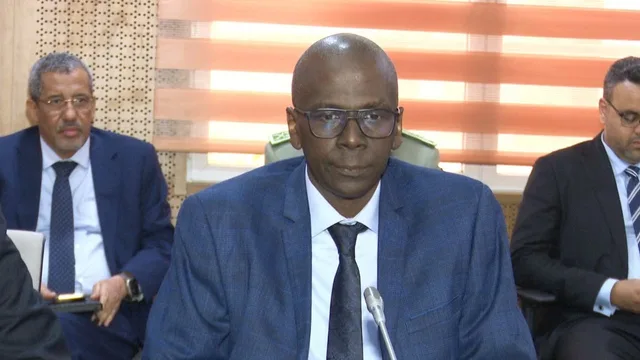
Madar (Nouakchott) - Finance Minister Koudiourou Moussa N'Gnour said on Wednesday evening, October 21, 2026, that the 2027 finance bill produces an overall surplus of 6.20 billion ouguiyas (MRU), with revenue of 152.11 billion against spending and net lending of 145.91 billion, describing it as "budget sovereignty" that he called an exception in the sub-region, according to the Mauritanian News Agency (AMI).
The minister spoke at a press briefing at AMI's headquarters, hours after the Council of Ministers approved the bill, while an IMF mission is in Nouakchott until November 1 to discuss public finances and energy.
The macroeconomic framework
The bill projects real growth of 5% in 2027, an average of 4.3% over 2027-2029, and inflation of 3.3%, "as the effects of the conflict in the Middle East persist", the minister said.
It is based on the 2027-2029 medium-term budget framework approved on July 1 and on the new fiscal rule adopted in June, which caps the non-extractive primary deficit at 3.5% of nominal GDP. That deficit is expected at 21.03 billion MRU (3.5% of GDP), compared with 22.18 billion (4%) in 2026.
Asked about the change between the 2026 and 2027 budgets, the minister said the surplus would not exceed 6 billion, seeing in it first a strengthening of budget sovereignty and second the state's ability to fund its investments from its own resources, "an important achievement".
Where does the investment go?
The bill allocates 11.59 billion MRU to the second phase of the Nouakchott development programme and 26.4 billion to the emergency programme for universal access to essential services for local development over 2025-2027.
In Dakhlet Nouadhibou, about 39.6 billion MRU will be mobilised for the 2026-2029 development programme, including 25.44 billion for productive infrastructure, notably the deep-water port and the fishing sector's wastewater treatment plant, 4.63 billion for water and sanitation, 3.06 billion for roads and transport and 3.03 billion for urban modernisation.
What it means for households
The minister said social measures continue the strategy followed since 2026: funding for the "Oun" operation rises by more than 6 billion MRU and cash transfers to vulnerable households by 1.6 billion, alongside various subsidies he did not detail.
Risks and safeguards
The minister acknowledged that the outlook remains exposed to internal and external risks: continued or renewed Middle East tensions, persistently high energy prices, slower disinflation raising subsidy costs, lower gold prices or disruptions to gas output, lower grants and concessional financing, and investment falling short of plans.
To counter them, the framework includes an overall spending ceiling in line with the new rule, a liquidity reserve in the treasury single account at the Central Bank of Mauritania and contributions to the national hydrocarbon revenue fund.
Open questions
The bill raises questions that the parliamentary debate and implementation will have to settle: will the 6 billion surplus withstand the subsidy bill if energy stays expensive? How far does 5% growth depend on gold and gas, which the minister himself lists among the risks? And will the increases for "Oun" and cash transfers reach households as fast as the cost of living demands?
The figures come days after IMF data showed Mauritania's debt ratios falling while its external debt stock stays near $4 billion.