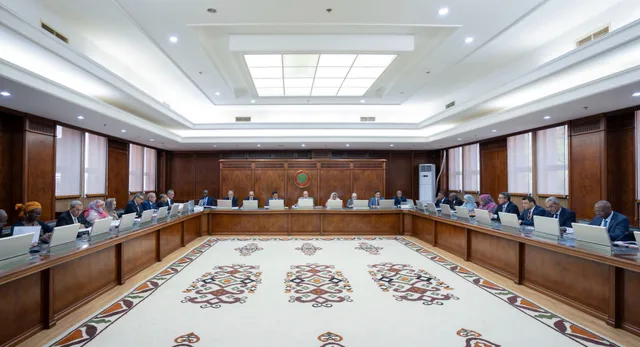
Madar (Nouakchott) - Mauritania's Council of Ministers, meeting on Wednesday, October 21, 2026, under President Mohamed Ould Cheikh El Ghazouani, approved the 2027 finance bill, which sets total revenue and grants at 152.11 billion new ouguiya (MRU) and total spending and net lending at 145.91 billion, for an overall surplus of 6.20 billion, according to the Council's official communiqué.
The bill is based on real economic growth of 5% in 2027 and an average of 4.3% over 2027-2029, with inflation of about 3.3%, "in an international environment still affected by the repercussions of the conflict in the Middle East", the communiqué said.
It applies a new fiscal rule, set by an organic law passed in June 2026, that caps the primary balance excluding extractive revenue at 3.5% of nominal GDP. That balance is projected at minus 21.03 billion MRU in 2027 (-3.5% of GDP), against minus 22.18 billion (-4%) in 2026.
Flagship investments include the second phase of the Nouakchott development programme (11.59 billion MRU), the emergency programme for universal access to essential services (26.4 billion over 2025-2027) and the Dakhlet Nouadhibou development programme (about 39.6 billion over 2026-2029), including 25.44 billion for productive infrastructure such as the deep-water port.
The communiqué listed risks including continued tensions in the Middle East, high energy prices, slower disinflation and higher subsidy costs, lower gold prices or an incident in gas production, and a decline in grants and concessional financing.
The Council also approved six health-sector draft decrees covering medical devices, local drug manufacturing, hazardous, toxic and narcotic substances, the optician profession, dietary products and laboratory reagents.
It took a single individual measure: appointing former SOMELEC director general Akhermbali Ould Mohamed Lehbib as head of the Mauritanian Hydrocarbons Company.