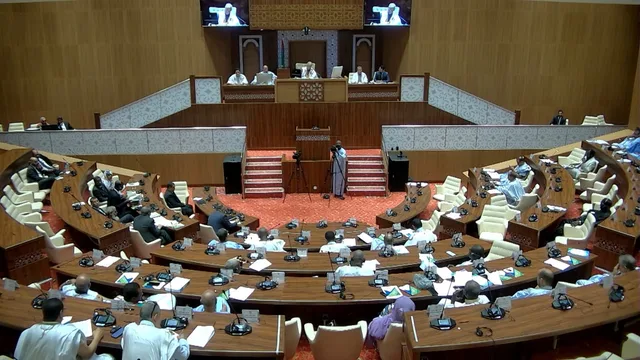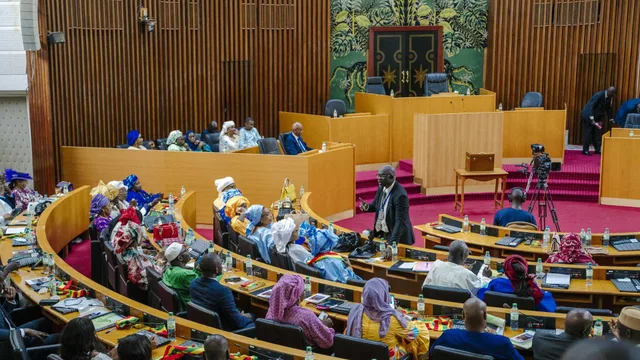
Madar (Nouakchott) - Mauritania's initial finance bill for 2027 has begun its passage through the National Assembly: the finance committee held two meetings on Thursday 12 November 2026, the first on the bill as a whole and the second on the budgets of the Presidency, the Prime Minister's office and Economic Affairs. It is the first stage of an in-depth review ahead of the plenary sitting set by the conference of presidents for Monday 28 December to debate and vote on the budget, according to the Mauritanian News Agency (AMI).
The minister of economic affairs and development, acting finance minister, presented the committee with the bill's main provisions, objectives and foundations, AMI said, and in the evening the budgets of the three sectors and their "areas of spending".
According to the bill, the Presidency's budget stands at 444.93 million ouguiyas and the Prime Minister's office at 720.16 million, while Economic Affairs and Development receives 4.47 billion ouguiyas.
The headline figures: 152.11 billion in revenue and a 6.20 billion surplus
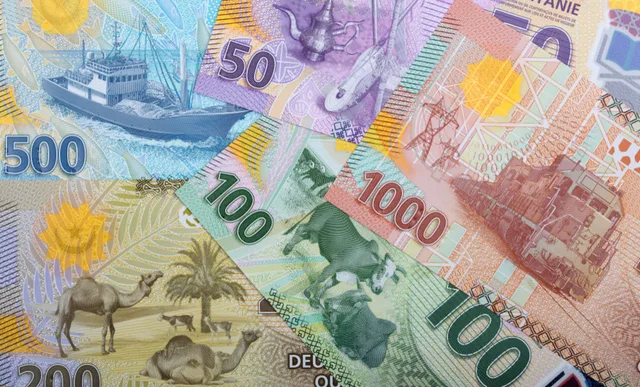
The bill projects total revenue of 152.11 billion new ouguiyas in 2027, including grants, against total spending and net lending of 145.91 billion, giving an overall surplus of 6.20 billion ouguiyas, according to the statement of the Council of Ministers that approved the bill on 21 October 2026.
The bill assumes real growth of 5% in 2027 and 4.3% on average over 2027-2029, with inflation of around 3.3%. Madar set out, in a detailed reading of the bill's annexes, how revenue, current spending and public investment compare with the 2026 amended finance law.
The first budget under the new fiscal rule
The 2027 budget is the first drawn up under the fiscal rule introduced by the new Article 46 of Organic Law No. 019-2026 of 1 June 2026 and its implementing decree No. 2026-090 of 3 June 2026, which keeps the primary balance excluding extractive revenue within 3.5% of nominal GDP, according to the Council of Ministers statement. The bill is based on the 2027-2029 medium-term budget framework approved by the Council of Ministers on 1 July 2026.
According to the same statement, revenue is projected first from the economic assumptions, and the room compatible with the primary balance target then sets an overall spending ceiling. This non-extractive primary balance, including grants, shows a deficit of 21.03 billion ouguiyas in 2027, or 3.5% of GDP, against 22.18 billion (4.0%) in 2026.
The finance minister told a press briefing at AMI on 21 October that the expected surplus "will not exceed 6 billion new ouguiyas", drawing two conclusions, including stronger "budget sovereignty", which he described as an exception in the sub-region, and the state's ability to finance national investment from its own resources.
Where the money goes
According to the Council of Ministers statement, the bill sets aside 11.59 billion ouguiyas for the second phase of the Nouakchott city development programme and 26.4 billion for the emergency programme for local development over 2025-2027.
The 2026-2029 development programme for the Dakhlet Nouadhibou region, approved in July 2026, carries an envelope of about 39.6 billion ouguiyas, including 25.44 billion for infrastructure supporting productive sectors, such as the deep-water port and a wastewater treatment plant for the fishing sector, 4.63 billion for water and sanitation, 3.06 billion for roads and transport and 3.03 billion for urban modernisation.
On the social side, the finance minister said allocations for the "Oun" operation would rise by more than 6 billion ouguiyas and cash transfers to vulnerable households by 1.6 billion, alongside other support in several areas.
The bill's annexes, as reported by Madar, show that the government expects 32.13 billion ouguiyas from mining, that the state's financial debt is projected at 219.3 billion ouguiyas at the end of 2026, and that tax exemptions cost the treasury 17.6 billion ouguiyas in 2025.
Risks and safeguards
The Council of Ministers statement acknowledges that the forecasts remain exposed to a return or continuation of tensions in the Middle East, meaning a lasting rise in energy prices, slower disinflation and a heavier subsidy bill, as well as to lower gold prices, a disruption in gas production, a rapid fall in grants and concessional financing, and lower-than-expected investment execution.
Against this, the statement cites three safeguards: the spending ceiling derived from the fiscal rule, a liquidity cushion in the treasury single account at the Central Bank of Mauritania, and contributions to the National Hydrocarbon Revenue Fund.
Between MPs' confidence and the IMF mission
The committee's work comes after the National Assembly gave Prime Minister Mokhtar Ould Djay's government its confidence by 145 votes, and coincides with the IMF mission for the first review of Mauritania's programme, whose head was received by the Prime Minister on Thursday 12 November on the eve of the end of its mission.
AMI did not report MPs' contributions at the two committee meetings or the timetable for reviewing other sectors' budgets, and had not published the IMF mission's conclusions by the morning of Friday 13 November. The budget remains before the finance committee until the plenary sitting scheduled for 10:00 on Monday 28 December.