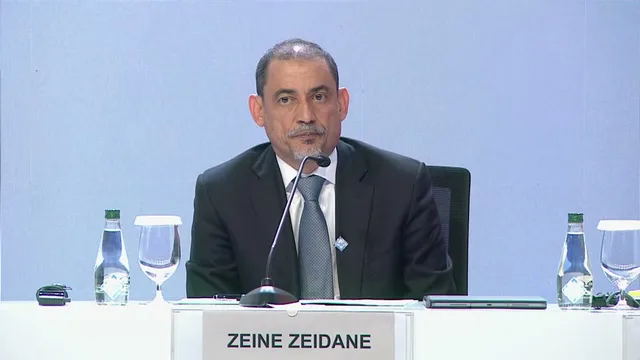
The International Monetary Fund expects sub-Saharan Africa's economies to grow by 4.5% in both 2026 and 2027, an increase of 0.2 percentage point from its April forecasts, while warning of mounting pressure on prices and public finances. Zeine Zeidane, director of the IMF's African Department, presented the outlook at a press briefing in Bangkok on Thursday, October 15, during the IMF and World Bank Annual Meetings, outlining the region's updated economic outlook.
It was Zeidane's first press conference as head of the department, which he took over in May from Abebe Aemro Selassie. Before joining the IMF in 2012, he served as Mauritania's prime minister from 2007 to 2008 and as governor of its central bank. African Department Deputy Director Monfort Mlachila also took part in the briefing.
Zeidane said the report's title, "Resilient Growth, Clouded Outlook", captured its central message. Growth had held up, he said, offering grounds for cautious optimism.
Reforms and adaptation
He attributed the region's resilience to earlier reforms and rapid adaptation, citing subsidy and exchange-rate reforms in Ethiopia and Nigeria and structural reforms in South Africa, which he said had strengthened macroeconomic stability. Global energy supplies had also been rerouted, inventories drawn down and businesses had adjusted their sourcing and logistics.
Asked why the growth forecast had been raised from 4.3% to 4.5%, Zeidane said purchasing managers' indices for the first six or seven months of the year showed that growth had held up strongly. The region had ended 2025 with its fastest growth in more than a decade, a nearly balanced primary fiscal position, stabilising debt, low inflation and improving current accounts. African countries had therefore entered the crisis with strong buffers, he said.
Resilience is not immunity
Zeidane cautioned that resilience did not amount to immunity. Regional figures masked sharply different experiences: higher oil, copper and gold prices were cushioning some exporters, while growth was slowing and external deficits were widening in economies less dependent on natural resources.
Median inflation in the region is projected to rise from 3.4% in 2025 to 4.3% this year and 5% in 2027, according to the figures he presented. Fuel and transport costs have already risen, while more expensive fertilisers could put further pressure on food prices and food security.
Governments have limited room to respond, he said. Fiscal adjustment before the shock had reduced deficits and debt ratios, but buffers remained thin. Interest payments absorb about 13% of government revenue in a typical country in the region, leaving less space for social spending and public investment. External borrowing remains expensive, while greater reliance on domestic banks can reduce the credit available to businesses. Bilateral aid to the region is expected to fall by a further 12% in 2026, following a steep decline last year.
Zeidane said risks were firmly tilted to the downside. Further energy supply disruption, a sharp increase in global risk aversion or a strong El Niño event could intensify pressures. Conflict and insecurity remain an additional drag in parts of the region.
Three priorities
He set out three priorities for policymakers, beginning with protecting vulnerable households while preserving scarce fiscal space. Broad fuel subsidies are expensive and poorly targeted, he said. In an illustrative scenario in the report, generalised fuel price support could cost about 4% of gross domestic product, compared with no more than half a percentage point of GDP for targeted transfers providing the same benefit to the poorest 40% of the population. Where delivery systems are weak, governments could use alternatives such as school feeding. Any temporary price support should be transparently funded, capped and time-limited.
The second priority is safeguarding economic stability. Exporters should save most of their windfall revenues, including by repaying costly debt. Countries facing higher import bills should maintain fiscal adjustment while protecting essential services and productive investment. Monetary tightening may be necessary in many countries to prevent temporary price pressures from becoming persistent inflation. Where the exchange-rate regime permits, greater flexibility can help absorb the shock and preserve reserves. Zeidane also stressed the importance of debt transparency.
The third priority is to maintain the focus on growth and reform, including more reliable electricity, better digital connectivity, stronger skills and a more predictable business environment. Regional integration in trade and energy is another important part of that agenda.
Closing his opening remarks, Zeidane said the region's resilience was real, but must not be financed by sacrificing future growth.
A potential engine of global growth
Turning to the transition from stability to growth, he said Africa's young, rapidly expanding population could make the continent an engine of global growth, provided it mobilised more capital, including domestic savings. He cited IMF analysis indicating that closing half the gap in governance, the business environment and international integration could raise the continent's GDP by more than 20% over five to ten years.
Countries in the region issued about $12 billion in international bonds during the first nine months of the year, he said. Their efforts to narrow yield spreads had been offset by higher benchmark rates, with yields on ten-year US Treasury bonds rising by more than 100 basis points. Borrowing costs had therefore not actually declined, in his assessment, and decisions to access international markets should be considered case by case.
On artificial intelligence, Zeidane cited an IMF paper suggesting that wider adoption and use of the technology could add more than four percentage points to the region's growth over ten years, or about 0.4 percentage point annually. He highlighted opportunities in agriculture, education, health and government services. Exporters of critical minerals could also benefit from the energy transition and AI-related demand. Its overall impact on employment remains uncertain, he added, while the African workforce's exposure to AI is still low.
Senegal debt talks moving forward
Asked about Senegal's debt, Zeidane gave an upbeat assessment of the talks. The IMF and the authorities had reached a staff-level agreement, he said. The government was advancing reforms supported by the programme, had hired financial advisers and had expressed interest in a debt treatment under the G20 Common Framework.
A first Global Sovereign Debt Roundtable meeting on Senegal was held on Wednesday with the country's main official bilateral creditors and the Senegalese minister present, he said, describing the discussions as positive. The IMF had also offered its good offices for the first time in a structured way to facilitate a swift debt treatment. An initial meeting under that arrangement, bringing together official and private creditors, had taken place about a week earlier. Discussions were moving in the right direction, he said.
He did not give a deadline for completing the process, but explained that taking a programme to the IMF Executive Board requires financing assurances from official creditors. Those assurances are distinct from a debt-treatment agreement. If the Common Framework creditor committee agrees to Senegal's proposal, the IMF can regard that as financing assurances, opening the way for the Board to approve the programme before individual negotiations with each creditor. Memorandum-of-understanding templates developed with G20 countries through the roundtable could help speed up the process.
Nigeria, Ethiopia and Cameroon
For Nigeria, Mlachila said the Fund was raising its growth forecasts to 4.2% this year and 4.3% next year, supported by improved oil prices and foreign-exchange receipts, alongside falling inflation. Zeidane recommended mobilising more non-oil revenue and gradually phasing out energy subsidies, which he said disproportionately benefit wealthier households, while directing the savings towards people most in need. He advocated supporting people rather than products. He also described the Nigerian central bank's interest-rate normalisation as appropriate, while noting that its monetary stance remained tight.
On the redistribution of IMF quotas, Zeidane said discussions among members were continuing. The managing director had stressed that low-income countries would be protected against losing quota shares, he said. Ethiopia's rapid growth meant it could benefit from a new formula. A review of the debt sustainability framework for low-income countries would also broaden assessments to cover domestic debt and long-term factors such as growth and climate.
For Cameroon, a post-financing assessment mission had completed its work. The country was not yet at the stage of requesting a programme, Zeidane said, while confirming that dialogue with the authorities was continuing.
Asked about the launch of the African Credit Rating Agency, he said the IMF did not intervene in rating agencies' work. The best way to lower borrowing costs was to strengthen economic fundamentals, establish a credible fiscal framework, ensure full fiscal and debt transparency and deepen local-currency debt markets, including through pension funds and the insurance sector.