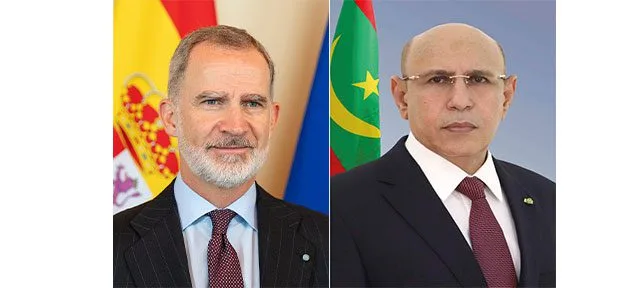

Spain's King Felipe VI and Queen Letizia are due to visit Ceuta on Tuesday 13 October before travelling to Melilla on Wednesday 14 October, according to the royal household's agenda. The trip follows the mass arrival of migrants in late July and renewed disagreements between Madrid and Rabat over migration cooperation, alongside the longstanding dispute over sovereignty of the two cities.
It will be Felipe VI's first official visit to the cities since he became king in June 2014. Spain administers Ceuta and Melilla as autonomous cities in North Africa, while Morocco claims them. That disagreement gives the trip political significance beyond its local programme. Madrid presents it as a head of state's visit to two Spanish cities.
Official meetings and a tribute to those who died
In Ceuta, the programme includes meetings with local authorities, the governing council and civil society, as well as a school visit. The king and queen are also scheduled to attend a ceremony at Sidi Embarek cemetery remembering people who died at sea on 30 and 31 July, with representatives of the city's four faiths, the royal household says.
In Melilla, a reception at the Assembly Palace and meetings with the authorities and governing council will be followed by a school visit and a gathering with local society. Spanish news agency EFE reports that the royal couple will spend Tuesday night in Ceuta before travelling to Melilla. The trip is coordinated with the government, but Prime Minister Pedro Sánchez will not accompany them.
July's crisis and disputed responsibility
Tens of thousands of people crossed from Morocco into Ceuta on 30 and 31 July, in a crisis that caused deaths and put severe pressure on accommodation and public services. Spanish media have reported estimates of about 80,000 arrivals over the two days. On 12 October, El País reported that Sánchez put the crisis-related death toll at 140.
The number of arrivals does not represent the number still in Ceuta. Addressing parliament on 3 September, Sánchez said about 63,000 people had returned to Morocco within the first 72 hours. He described a subsequent phase focused on the humanitarian response and stronger public services, including additional reception capacity, support for the city's economy and a request for European assistance.
In explaining the crisis, Sánchez pointed to misleading accounts of a Supreme Court ruling and their exploitation by smuggling networks. Spain's foreign ministry clarified on 3 August that the ruling sets procedures for people arriving by sea. It does not confer a right to remain or travel to mainland Spain, nor does it prevent returns carried out through legal procedures.
The causes of the crossings and the Moroccan authorities' role nevertheless remain disputed. In his 3 September address, Sánchez said the government had not, by that date, received solid evidence that Morocco planned or carried out the episode. On 10 September, Morocco's foreign ministry rejected accusations of involvement and criticised the use of Morocco in Spain's domestic political debate, according to El País.
Rabat's message and Sánchez's latest remarks
Opening parliament on 9 October, Mohammed VI said the existing cooperation model had reached its limits and called for change. He criticised legal and judicial obstacles in migration cooperation and rejected a partnership based on pressure, without explicitly mentioning Felipe VI's trip.
On Monday, Sánchez confirmed that Moroccan military vessels entered waters off Ceuta during July's crisis, an episode revealed by El País. According to Europa Press, he said the two navies resolved the incident and it had not recurred, without drawing a causal link to the migrant arrivals. He defended the royal visit and cooperation with Morocco.
The 2007 precedent and the 2022 roadmap
The trip recalls Juan Carlos I and Queen Sofía's November 2007 visit, the last by a Spanish royal couple to the two cities. Morocco protested at the time and recalled its ambassador in Madrid, Omar Azziman, for consultations, making that visit an episode of diplomatic tension between the neighbours.
Bilateral rapprochement acquired a new framework in April 2022, when Sánchez and Mohammed VI agreed to expand cooperation and progressively restore the movement of people and goods at border crossings. In their joint declaration, Spain considered Morocco's Western Sahara autonomy initiative the most serious, realistic and credible basis for resolving the dispute. That was Spain's position on a proposed settlement, not an announcement that the conflict had ended.