Madar (Nouakchott) - Nineteen months after President Mohamed Ould Cheikh El Ghazouani named former minister Moussa Fall to coordinate an inclusive national dialogue, no start date had been announced as of Saturday, October 17, 2026. On Friday the ruling majority named its members of the dialogue's supervisory committee, prompting the Front for Citizenship and Justice (FCJ, Jemaa) to freeze its membership of the coalition.
The dialogue would be the eighth of its kind in a quarter of a century. Since 2005, Mauritania has held seven major rounds of political dialogue and consultation, each tied to a president and each with a different fate: referendums and constitutional amendments, electoral deals, or suspension with no sequel.
The current dialogue: 19 months of preparation
In March 2025, Ghazouani announced a political dialogue and tasked Moussa Fall with coordinating it, describing it as an "extension" of the 2022 consultation. In October 2025, Fall said the preliminary phase had involved 20 recognised parties, 50 parties awaiting registration, 240 independent figures and some 1,500 citizens, and that only the AJD/MR party and lawmaker Biram Dah Abeid had boycotted it.
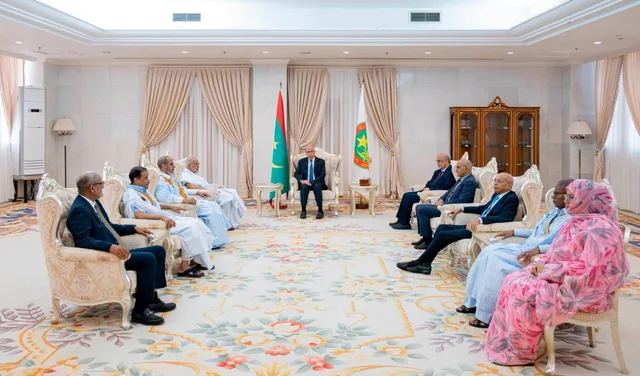
On January 6, 2026, meeting opposition figures, the president said he "will leave power tomorrow or the day after" and that the dialogue concerns issues affecting the country's future, according to the Asharq Al-Awsat newspaper. The process stalled on March 30, 2026, however, when the coordinator suspended a meeting after a dispute over a clause on "terms and mandates" proposed by the majority, which the opposition wanted removed.
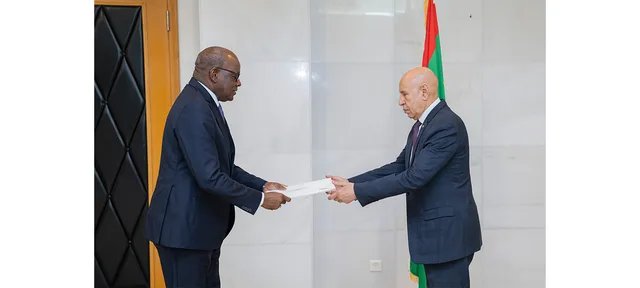
The deadlock lasted until July 14, 2026, when the parties signed the dialogue's reference document after the clause was dropped. It was signed for the majority by El Insaf party president Mohamed Ould Bilal Messoud, for the institution of the opposition by Hamadi Ould Sidi Mokhtar, for the Coalition of the Democratic Opposition by Mohamed Ould Maouloud and for the Rally of Democratic Forces by Ibrahim Ould Ebeihi. Ghazouani received the document on July 24 and on August 25 asked Fall to chair the supervisory committee.
On September 3 the parties agreed on a 20-member committee, with 7 seats for the majority, 7 for the opposition and 6 for civil society and independents, and names due by September 30. The majority postponed choosing its members the same day, then gave itself "extra time" on October 2.
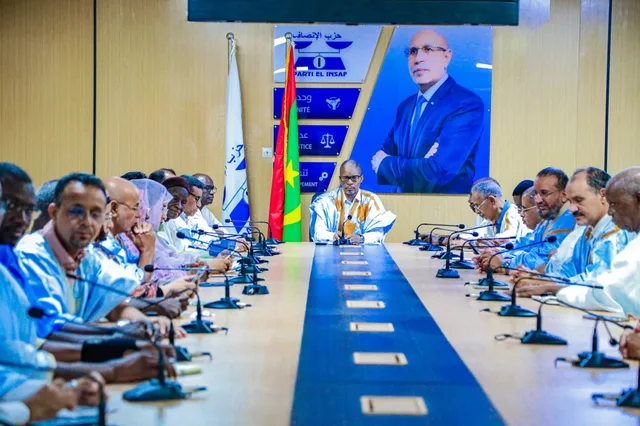
On October 14, acting government spokesman Mohamed Maa El Ainine Ould Ayeh said moving to the dialogue's practical stages "now requires parties and political forces to complete the necessary arrangements". Two days later the majority's coordination named its members, with Ould Bilal as committee vice-chair, using the number of MPs and then of municipal councillors as the criterion. The FCJ rejected the list, and its leader, Mohamed Jemil Ould Mansour, told Sahara 24 he had found out the names from a WhatsApp group.
Outside the process, Biram Dah Abeid is boycotting the dialogue and in September urged the opposition to pull out, warning it could become a "formal facade". The AJD/MR and the Alliance of Salvation Forces, which announced its boycott in July citing "the little time left" in the presidential term, are also staying away. Ghazouani said in Atar on September 20 that the dialogue is not meant to "touch the foundations of the state" and must be free of "taboos or dictates".
A quarter of a century of dialogues
Under Maaouiya Ould Sid'Ahmed Taya, the opposition Union of Forces of Progress (UFP) called in July 2002 for a national dialogue between the government and the opposition, and its leader Mohamed Ould Maouloud met the president, while other opposition parties held back, according to Al Jazeera's archive. Taya's rule ended in the coup of August 3, 2005. That October, Ely Ould Mohamed Vall's military council held "national consultation days" that led to the June 2006 referendum, approved by about 97 percent, which limited the presidential term to five years, renewable once.
In November 2007, President Sidi Ould Cheikh Abdallahi held consultation days on past human rights abuses and the return of refugees, followed by the return of thousands of refugees from Senegal, before he was toppled on August 6, 2008. The Dakar Accord, signed in early June 2009 under the mediation of Senegalese President Abdoulaye Wade, ended the crisis with a national unity government and the July 18, 2009 presidential election.
Under Mohamed Ould Abdel Aziz, a dialogue in September and October 2011 brought together the majority and four parties of the Coordination of the Democratic Opposition, while the rest of the Coordination boycotted it. It led in early 2012 to constitutional amendments that criminalised coups and created an independent electoral commission. Attempts at dialogue with the opposition Forum then failed before the 2014 presidential election, which it boycotted, and a preliminary meeting also failed in April 2018.
From September 29 to October 21, 2016, a new "inclusive national dialogue" took place, boycotted by the Forum and the RFD. It recommended abolishing the Senate and changing the flag and anthem, while ruling out any change to term limits. The Senate rejected the amendments on March 17, 2017 by 33 votes to 20, before they were adopted by referendum on August 5, 2017, and they remain politically contested.
Under Ghazouani, the national consultation overseen by Yahya Ould Ahmed Waghef was suspended on June 2, 2022, on the eve of its workshops, and never resumed. An agreement signed by 24 of 25 parties with the Interior Ministry on September 26, 2022, did however pave the way for the elections of May 13, 2023.
What the numbers say
Seven major rounds since 2005, separated by four years, then two, five, six and three. Some ended in referendums and amendments, others in electoral deals, one was simply halted. Three patterns recur: part of the opposition boycotting, the question of presidential terms, from the 2006 referendum to the 2026 clause on "terms and mandates", and a gap between announcing a dialogue and actually opening it.
After 16 months of preparation, according to its coordinator, and six documented delays and stalls, the current dialogue still hinges on the formation of its supervisory committee and on a presidential decision on when it will begin.