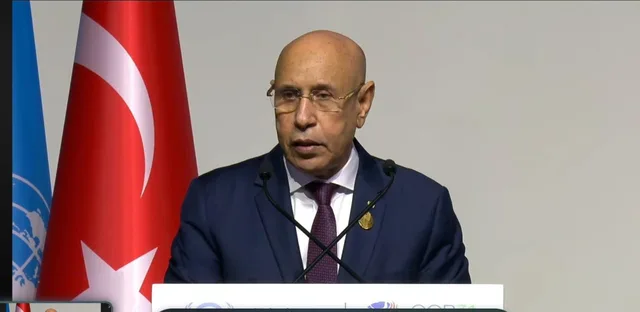
Madar (Nouakchott) - President Mohamed Ould Cheikh El Ghazouani has called for "easily accessible climate finance suited to the needs of our countries", saying that Mauritania, "despite its small carbon footprint, remains among the countries hardest hit by climate change and its destructive effects", in a speech to the second session of the Antalya leaders' summit at the 31st Conference of the Parties to the UN Framework Convention on Climate Change (COP31), the text of which the Mauritanian News Agency (AMI) published on Wednesday 11 November 2026.
The president listed drought, water shortages, land degradation, desertification and coastal erosion, which he said had helped "tear apart our rural social and economic fabric, threaten our food security and hinder our development" through their impact on marine and natural ecosystems. Tackling climate change and adapting to it ranks, he said, "among the most pressing social and economic priorities, and indeed security priorities too".
Ghazouani opened by congratulating Turkey on its presidency and organisation of the conference, thanking Brazil for its efforts at the helm of the previous session and praising Australia's role in leading the negotiations, before wishing success to Ethiopia, which will host the 32nd session.
What Mauritania announced in Antalya
According to the president, Mauritania is carrying out programmes with its partners to build resilience, restore degraded land and combat desertification, including its contribution to the Great Green Wall initiative and its role in the Sahel Region Climate Commission and the Permanent Interstate Committee for Drought Control in the Sahel (CILSS).
He said the country had adopted its third nationally determined contribution with a 2035 horizon, that the related investment plan was being prepared and that "our national adaptation plan is close to completion", adding that the two frameworks would allow better planning of interventions, mobilisation of resources and measurement of progress "in a transparent manner".
He also spoke of building a "broad social safety net" to support the neediest households in the face of climate shocks, and of reforms to mainstream climate in public policy: mechanisms to track climate spending and budgets, a review of water policy, cutting greenhouse gas emissions in the extractive sector and including climate criteria in the selection of public investment projects, alongside harnessing renewable energy and developing green hydrogen.
Beyond finance, he called for more technology transfer, institutional capacity building and technical assistance, voicing hope that the conference would be an opportunity "to build trust between the parties and accelerate the implementation of the Paris Agreement".
The third contribution in figures
According to the text of the third nationally determined contribution (NDC 3.0), drawn up by the Ministry of Environment and Sustainable Development and published on the website of the UN Framework Convention on Climate Change, Mauritania commits to cutting its net greenhouse gas emissions by 75.8% by 2035 compared with the reference scenario, including 8.1% through unconditional national effort and 67.7% conditional on international support.
The document puts financing needs at $18,088.33 million, of which $15,642.85 million depends on external funding and $2,445.48 million can be mobilised nationally. Mitigation accounts for $12,103.62 million and adaptation for $5,808.66 million.
NDC 3.0 includes 63 mitigation measures, 39 unconditional and 24 conditional, covering energy, agriculture, land use and forestry, industrial processes and waste, and targets more than 13 GW of installed renewable capacity by 2035. In the conditional scenario it relies on the green hydrogen programme, "under development", to avoid emissions in the energy sector, and it plans to raise the share of clean energy supplying mining sites to 40% by 2030.
The adaptation component comprises 85 measures in water, agriculture, food security, fisheries, health, housing, education and ecosystem conservation.
Vulnerability in numbers
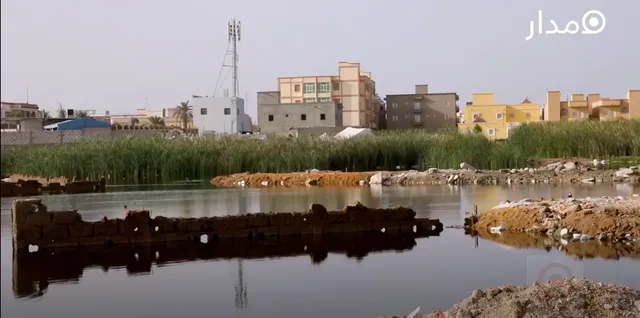
The document cites an International Monetary Fund estimate that climate shocks cost Mauritania an average of 1% to 2% of GDP a year, and a climate profile projecting more urban flooding in Nouakchott and pasture losses in the south of the country. The capital and coastal areas face erosion, saline intrusion and sea-level rise along a 720-kilometre coastline.
That vulnerability has shown up in recent weeks: Assaba region moved to expand fodder crops amid signs of a rain shortfall, while Guidimakha saw anticipatory action to limit the impact of drought on farmers and herders, backed by the UN Central Emergency Response Fund and the FAO.
In Nouakchott, the finance minister on 5 November discussed the launch of works to protect the capital's coastline against erosion and marine flooding, while on Wednesday the government signed with France a 41 million euro agreement to improve water services in Nouakchott and Nouadhibou.
From Antalya to Dakar
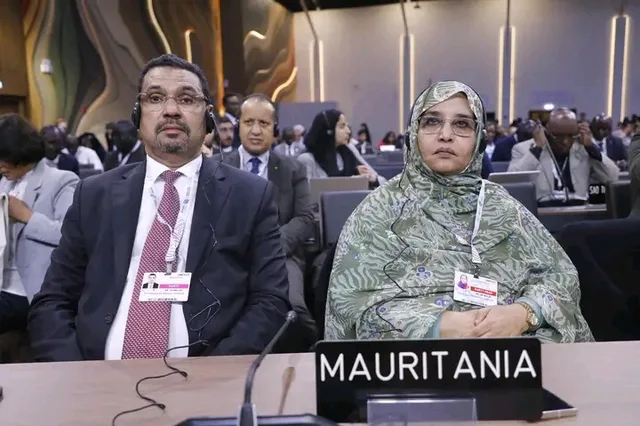
Environment Minister Messouda Mint Baham Mohamed Laghdaf had travelled to Antalya on 7 November for the conference, which opened on 9 November with an appeal from the UN Secretary-General, before President Ghazouani headed to Turkey for the leaders' summit that opened on Wednesday. Among Mauritania's neighbours, Malian Prime Minister Abdoulaye Maiga represented transitional President Assimi Goita.
In the region, Senegal announced on 2 November that its third contribution targets a 48.5% emissions cut by 2035 with international support, and 19.4% without, with financing needs it puts at $24.9 billion. Madar published two stories on Wednesday on Ghazouani's speech at the summit and on the adoption of the third contribution and the adaptation plan.