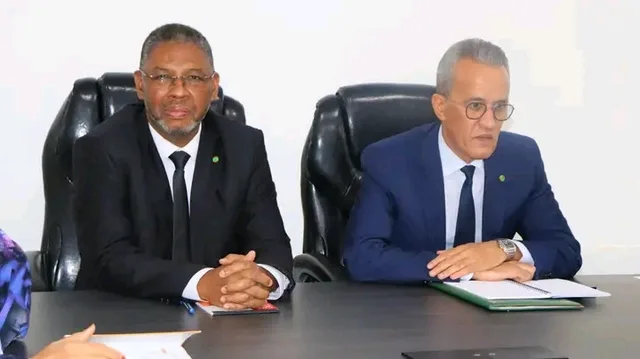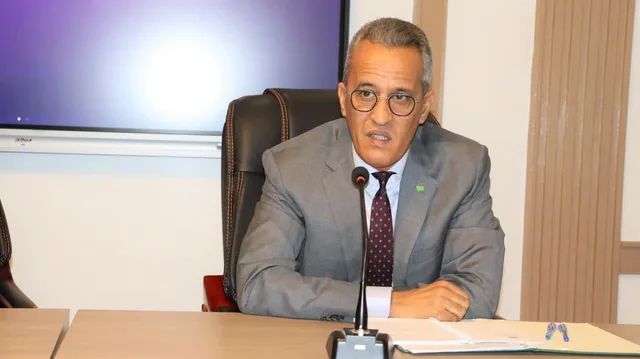
Madar (Nouakchott) - Mauritania's Ministry of Interior, Promotion of Decentralisation and Local Development has pledged to give "new momentum" to the transfer of powers from the state to regional councils and to "speed up" the process, while regional presidents asked for the "institutional, financial and human conditions needed" to exercise those powers, at a meeting Minister Mokhtar Ould Ahmed Boussef held with them on Thursday, 19 November 2026, at the ministry in Nouakchott, according to the Mauritanian News Agency (AMI).
The meeting, attended by the minister delegate for decentralisation and local development, Yacoub Ould Salem Vall, capped a week of official meetings on the file with regional governors, mayors and technical partners. Madar reported the details of the meeting.
What the minister said
Ould Ahmed Boussef described decentralisation as "an irreversible national choice" and presented the regional councils as an institutional tier for running local affairs and a tool for carrying out development policy at regional level through planning, setting priorities and aligning public action. He called for "a new dynamic of joint work" between the central government and the regions and recalled the role of the National Council for Decentralisation and Local Development, chaired by President Mohamed Ould Cheikh El Ghazouani.
On the transfer of powers, the minister called for an approach that "defines competences, clarifies responsibilities and ensures that transferred powers come with the human and financial resources and the means needed to exercise them", saying the effectiveness of decentralisation "remains tied to the extent to which regional bodies are able to exercise their competences in practice", AMI reported.
What the regions asked for
The regional council presidents set out, according to the same source, the main issues in running the regions and the difficulties they face in exercising their powers, and made proposals, stressing the activation of the National Council for Decentralisation, a faster transfer of powers and coordination with the supervising ministry and other government departments. The official account does not detail those proposals and gives no figures or timetable.
A week of meetings
The minister had met the regional governors on 12 November to review territorial administration, decentralisation and stalled development projects, then met the bureau of the Association of Mauritanian Mayors on Tuesday, 17 November, urging municipalities to help with cleanliness and the urban environment, while the minister delegate reminded mayors of the support already given to municipalities and of the need to "raise the level of effort".
The same day, the minister delegate opened a workshop in Nouakchott on the budget and accounting nomenclature of local authorities, organised by the Directorate General of the Treasury and Public Accounting with German cooperation and attended by regional presidents and the mayors of Nouakchott and the regional capitals. He said integrating the nomenclature into the "Sijil" system marked progress in digitising local financial management. He also chaired the third meeting of the technical group of technical and financial partners working on decentralisation and local development.
Education, health and environment
The file does not start from scratch. Prime Minister Mokhtar Ould Djay told the National Assembly on 22 January 2026 that the government had held "in-depth consultations" on transferring some powers in education, health and the environment to municipalities and regional councils, producing "a roadmap for approving the transfer process", alongside a plan to build the capacity of local staff and a performance evaluation mechanism covering 21 municipalities in its first phase, according to AMI.
The prime minister pledged at the time to give "more powers and resources to regional and municipal councils" and said 2026 would see "an increase in the resources of the Local Development Fund and the budgets of the regional councils". Since then, the government has not announced, in what AMI has published, the approval of the roadmap or a list of powers actually transferred.
The money on the table
On funding, the 2027 finance bill, adopted by the Council of Ministers on 21 October, allocates 26.4 billion new ouguiyas to the emergency local development programme over 2025-2027. The bill, which has begun its passage through parliament, is due to be voted on in a plenary session on 28 December 2026.
Results of the programme's first phase vary from region to region. In Guidimakha, completion stood at 54%, with 115 of 215 interventions finished, 91 under way and 9 not started, the minister delegate said on 30 October, while phase one continues until March alongside preparations for phase two.
Some regions are moving with their own resources and partnerships. The Inchiri regional council adopted the region's 2027 budget at its fourth ordinary session on 12 November, and the Guidimakha regional council is preparing a portfolio of 16 programmes and 64 projects to present to partners ahead of a farming and livestock fair in Selibaby in March 2027.
What comes next
The ministry said Thursday's meeting was part of a drive to strengthen the institutional partnership with the regions, activate coordination and consultation mechanisms, speed up the transfer of powers and develop the regions' institutional capacity. No date has yet been announced for a new session of the National Council for Decentralisation and Local Development, nor a timetable for transferring specific powers.